

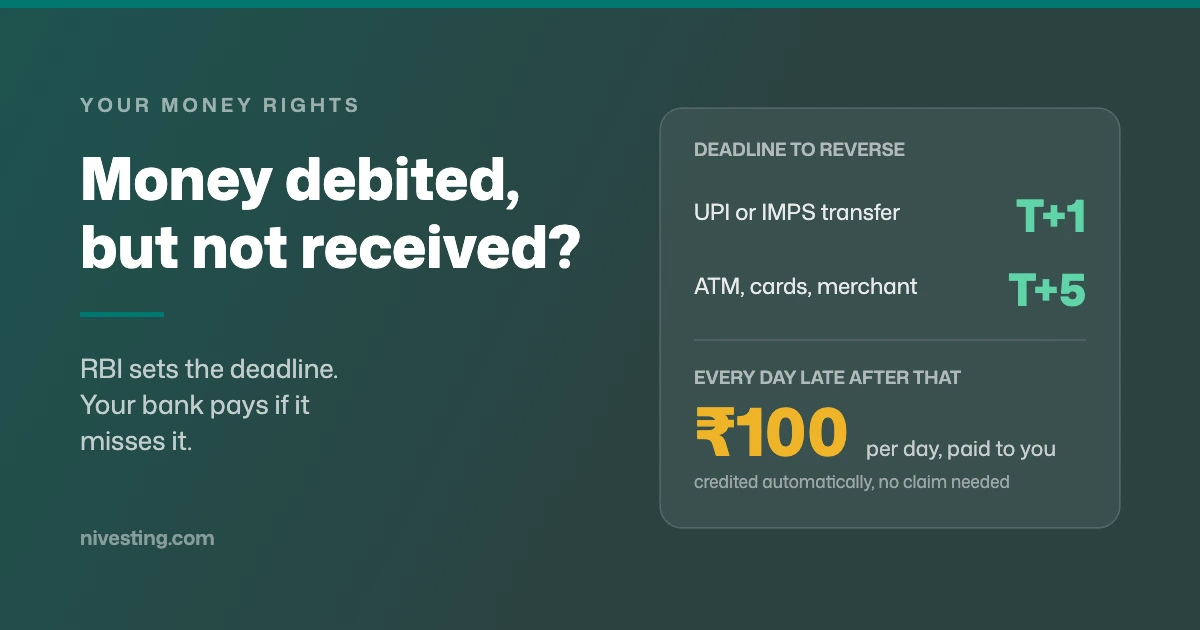
Your bank has a deadline, and if it misses it you are owed ₹100 for every day of delay. For UPI and IMPS transfers where the money left your account but never reached the other person, that deadline is the next calendar day. For ATM withdrawals where cash never came out, it is five days.
The part almost nobody knows: that compensation is supposed to be paid to you automatically. You do not have to ask for it, claim it, or even complain. The rule says so explicitly.
This all comes from a single RBI circular, Harmonisation of Turn Around Time and customer compensation for failed transactions (RBI/2019-20/67), in force since 15 October 2019. It covers eight different payment systems. Here is what it says about yours.
UPI money debited but not credited
This is the most common version of the problem. You send money, your account is debited, and the recipient says nothing arrived.
Under the framework, if the beneficiary account cannot be credited, the beneficiary bank must auto-reverse the transaction by T+1 day at the latest. Beyond that, compensation of ₹100 per day of delay applies.
If instead you were paying a merchant and the payment failed to confirm at their end, the deadline is longer: auto-reversal within T+5 days, then ₹100 per day.
So the answer to “how long should a UPI refund take” is one day for a person-to-person transfer, and five for a merchant payment. Anything past that is a breach with a price attached.
ATM cash not dispensed but account debited
You requested cash, the machine did not deliver, and your balance dropped anyway.
The bank must carry out a proactive reversal within a maximum of T+5 days. After that it is ₹100 per day of delay, credited to the account holder. The circular explicitly names non-availability of cash in an ATM as a qualifying failure, so the bank cannot treat an empty machine as your problem.
The same T+5 window applies to Micro-ATMs.
IMPS and other bank transfer failures
For IMPS, where your account is debited but the beneficiary account is not credited, the beneficiary bank must reverse by T+1 day, with ₹100 per day beyond that.
The same T+1 deadline covers the Aadhaar Payment Bridge System and NACH, both of which handle salary credits, pensions, subsidies and mandate-based debits. NACH carries one extra provision worth knowing: if your account is debited after you revoked a debit mandate, your own bank is held responsible, and it has until T+1 to resolve it.
How long a failed transaction refund actually takes
Two definitions decide everything here, and both are in the circular.
T is the day of the transaction, and it is a calendar date. Not a working day. Weekends and holidays count, which means a Friday evening failure does not buy the bank until Tuesday.
A failed transaction is one that did not complete for a reason not attributable to you. The circular lists communication link failures, empty ATMs and session time-outs. It also, importantly, includes credits that failed because of missing or incorrect information, and delay in initiating a reversal. A bank cannot classify its own slow reversal as something other than a failure.
One boundary: the framework covers domestic transactions only, meaning both sender and recipient are in India.
The ₹100 a day almost nobody claims
This is the provision that changes the situation, and it is worth quoting directly:
Wherever financial compensation is involved, the same shall be effected to the customer’s account suo moto, without waiting for a complaint or claim from the customer.
Suo moto means the bank must act on its own initiative. The compensation is not a goodwill payment you negotiate, and it is not conditional on you noticing. A bank that reverses a failed UPI transfer on day four and credits nothing extra has not quietly done you a favour, it has fallen short of the framework twice over.
There is no cap stated in the table. The ₹100 per day runs for each day of delay.
Who receives it depends on where the failure sat. The circular sets out the principle plainly: if the beneficiary was not credited in time, the penalty is paid to the beneficiary; if the delay was at the originating end, it is paid to the originator.
Every system covered, and the deadline for each
The full framework spans eight payment systems. The compensation is ₹100 per day of delay in every single case, so the only variable is the deadline.
| Payment system | What went wrong | Deadline |
|---|---|---|
| ATM and Micro-ATM | Debited, cash not dispensed | T+5 |
| UPI | Debited, beneficiary not credited | T+1 |
| UPI | Debited, merchant did not get confirmation | T+5 |
| IMPS | Debited, beneficiary not credited | T+1 |
| Card to card | Debited, beneficiary card not credited | T+1 |
| Card at PoS | Debited, no charge slip generated | T+5 |
| Card online (e-commerce) | Debited, merchant did not get confirmation | T+5 |
| AePS and Aadhaar Pay | Debited, no confirmation at merchant | T+5 |
| APBS | Delay crediting beneficiary | T+1 |
| NACH | Delay crediting or reversing | T+1 |
| NACH | Debited after mandate revoked | T+1 |
| Wallets and PPIs | On-us: not credited, or no merchant confirmation | T+1 |
For wallet transactions that travel over UPI, a card network or IMPS, the rule of that underlying system applies instead. And note that the circular defines “bank” to include non-banks wherever they are authorised to operate, so wallet providers and payment fintechs are inside the framework, not outside it.
What to do when the deadline passes
The escalation path is short, and the circular names it.
- Establish your T. Note the transaction date, the UTR or reference number, and the amount. T is the calendar date of the transaction.
- Raise it with your bank or the payment provider first, through a channel that leaves a record. Ask specifically for the reversal and for the compensation due under the TAT framework, citing the circular by name.
- If redress does not follow, complain to the RBI Ombudsman. The circular states that customers who do not get the benefit of redress as defined in the TAT can register a complaint under the Reserve Bank Integrated Ombudsman Scheme, 2021. Complaints are filed at cms.rbi.org.in.
- Keep the arithmetic simple. Days of delay beyond the deadline, multiplied by ₹100.
The framework is issued under Section 10(2) read with Section 18 of the Payment and Settlement Systems Act, 2007, which is what gives it force rather than leaving it as guidance.
Frequently asked questions
UPI money debited but not credited, what should I do?
If the recipient was not credited, the beneficiary bank must auto-reverse by T+1 day. If it has been longer, you are owed ₹100 for each additional day, and it should have been credited without you asking. Raise it with your provider citing the TAT framework, then escalate to the RBI Ombudsman if nothing happens.
How long does a failed UPI transaction refund take?
One calendar day (T+1) for a transfer to another person. Five days (T+5) for a payment to a merchant that did not confirm.
Do I have to ask for the ₹100 per day compensation?
No. The circular requires it to be credited suo moto, meaning on the bank’s own initiative, without waiting for a complaint or claim. In practice many people do have to chase it, which is exactly why knowing the provision exists matters.
Is the deadline in working days or calendar days?
Calendar days. The circular defines T as the day of the transaction and refers to the calendar date, so weekends and public holidays are included in the count.
ATM debited but no cash, how long does the bank have?
A proactive reversal within a maximum of T+5 days, then ₹100 per day of delay credited to the account holder.
Does this cover Paytm, PhonePe, GPay and other wallets?
Yes. The circular states that the term bank includes non-banks wherever they are authorised to operate. For wallet transactions riding on UPI, cards or IMPS, that underlying system’s deadline applies.
Does it apply to international transactions?
No. The framework covers domestic transactions only, where both the originator and the beneficiary are in India.
Is there a limit on the total compensation?
The table states ₹100 per day of delay without specifying a cap, and it runs until the reversal is concluded.
Sources
| Claim | Source |
|---|---|
| All deadlines and the ₹100 per day figure across eight payment systems | RBI circular DPSS.CO.PD No.629/02.01.014/2019-20 (RBI/2019-20/67), 20 September 2019, Annex |
| Compensation payable suo moto, without a complaint or claim | Same circular, paragraph 5 |
| Escalation to the Integrated Ombudsman Scheme, 2021 | Same circular, paragraph 6 |
| T is the calendar date of the transaction; definition of a failed transaction; domestic scope; non-banks included | Same circular, Annex, General Instructions covering the TAT |
| Legal basis and effective date | Payment and Settlement Systems Act, 2007, Section 10(2) read with Section 18; effective 15 October 2019 |
General information only, not financial or legal advice. Regulations are amended from time to time, so confirm the current text of the circular before relying on it. See the Disclaimer and Editorial Policy.
Related reading
- Should you close a credit card in India?. Another enforceable deadline most people never hear about, this time seven working days and ₹500 a day.
- How UPI is making you spend more without realising it. The behavioural side of the same payment rail.
- Ask about your own case in the community. Useful if you are trying to work out which system a failed payment actually rode on.

Leave a Reply