

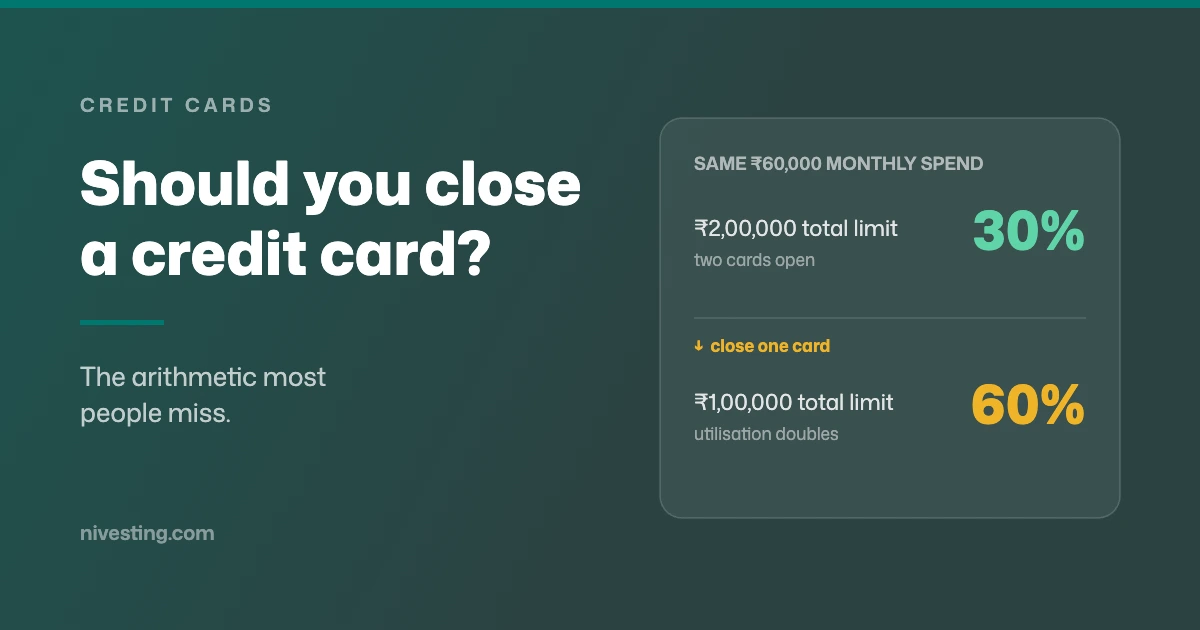
Usually not. The reason is arithmetic, not sentiment. Closing a card removes its credit limit from your total, so the same monthly spending suddenly represents a much higher share of the credit available to you. That ratio is one of the largest inputs to your score.
There are cases where closing is the right call, and this page works through each of them: an unused card, a card you have just paid off, a card that has started charging a fee, and the worst possible timing, which is closing just before you apply for a loan.
It also covers the part almost nobody mentions: when you do close a card, the RBI gives you an enforceable seven-working-day deadline and ₹500 a day if the issuer misses it.
Does closing a credit card hurt your credit score?
Two mechanisms do the damage, and both are calculable rather than mysterious.
1. Your utilisation ratio jumps. This is the share of your available credit that you are using. Suppose you hold two cards:
| Before closing | After closing the ₹1 lakh card | |
|---|---|---|
| Total credit limit | ₹2,00,000 | ₹1,00,000 |
| Monthly spend | ₹60,000 | ₹60,000 |
| Utilisation | 30% | 60% |
You changed nothing about your spending or repayment. The ratio doubled because the denominator halved. Bureaus read that as materially higher credit dependence.
2. Your average account age shortens. Length of credit history is a scoring input, and closing an old account pulls the average down. The older the card, the more it costs you to close, which is the opposite of most people’s instinct that old unused cards are clutter.
One thing this page will not do is quote a number of points. The bureaus do not publish their weightings, so any specific figure would be invented. The direction of both effects is well established; the magnitude is not public.
Should you close an unused credit card?
Generally no, if it is free. An unused no-fee card is doing quiet work for you: it contributes limit to your utilisation denominator and age to your history, while costing nothing.
Two caveats. Issuers sometimes close long-dormant cards themselves, so an occasional small transaction keeps it alive. And if the card tempts you into spending you would not otherwise do, the behavioural cost can outweigh the scoring benefit. That is a judgement about yourself, not about the arithmetic.
Should you close a card after paying it off?
Paying off a card and closing it are separate decisions, and people conflate them. Clearing the balance is what helps your score. Closing the account afterwards removes the limit you just freed up, which works against you.
If your goal was to stop using it, freezing or locking the card in your issuer’s app achieves that without surrendering the limit or the account age.
Should you close a card before applying for a loan or a new card?
This is the costliest timing, and it is the most common mistake. People tidy up their credit profile shortly before a home loan application, believing fewer cards looks more responsible.
The effect is usually the reverse. You reduce your total limit and raise your utilisation in the months a lender is looking hardest at your report. If you are planning a major application, the safer sequence is to leave your limits intact, keep utilisation low, and revisit any closures well after the loan is sanctioned.
What if the card starts charging an annual fee?
This is the situation where closing genuinely deserves consideration, because now there is a cost on the other side of the ledger. The question becomes a comparison rather than a reflex:
- What is the fee, including GST? An 18% GST applies on card fees, so the sticker figure is not the real cost
- Is there a spend-based waiver? Many cards waive the renewal fee above a spending threshold. If you would cross it anyway, the fee is effectively zero
- What would closing do to your utilisation? Run the calculation above with your actual limits
- How old is the card? An old card costs more to close than a recent one
If the fee is modest and the card carries a large, old limit, paying it can be cheaper than the scoring cost of losing it. If the fee is large and the limit is small, closing is straightforward.
Downgrade instead of closing
The option most coverage skips entirely. Many issuers will move you to a no-fee variant in the same family rather than lose you as a customer. Done this way you keep the account, its age and usually its limit, while the fee disappears.
It is worth asking explicitly for a downgrade or a fee waiver before submitting a closure request. Retention offers are common and not always advertised.
When closing genuinely is the right call
- The fee is real, there is no waiver, and no downgrade is offered
- The card is new, so little account age is lost
- Your remaining limits are large enough that utilisation barely moves
- You have no major loan or card application planned in the near future
- The card drives spending you regret, a behavioural reason that can outrank the arithmetic
Your rights when you close a card: the RBI rules
This is the part worth knowing before you start, and it comes straight from the RBI Master Direction on Credit Card and Debit Card issuance and conduct, Section E.
| What the rules require | Detail |
|---|---|
| Closure deadline | A closure request must be honoured within seven working days, provided all dues are paid |
| Penalty for delay | ₹500 per calendar day of delay, payable to you, until the account is closed, provided nothing is outstanding |
| How you can request it | Issuers must offer multiple channels: helpline, dedicated email, interactive voice response, a prominently visible link on the website, internet banking and the mobile app |
| What they cannot do | An issuer may not insist that you send the closure request by post, or by any route that delays it |
| Outstanding dues | If dues remain, the issuer must tell you what they are on receiving your request, without waiting for the billing cycle to end |
| After closure | You must be notified immediately, by email or SMS |
So if you decide to close, put the request through a channel that leaves a record, note the date, and keep the confirmation. The seven-working-day clock and the daily penalty are not goodwill gestures. They are conditions the issuer is required to meet.
There have been reported cases of banks paying substantial compensation for prolonged failure to close accounts on request, so the provision has teeth in practice as well as on paper.
The decision, in one table
| Your situation | Usually the better move |
|---|---|
| Free card, unused | Keep it; transact occasionally so it is not closed for dormancy |
| Just paid off the balance | Keep the account; freeze the card if you want to stop using it |
| Loan or card application coming up | Change nothing until it is sanctioned |
| Fee introduced, spend waiver achievable | Keep it and cross the threshold |
| Fee introduced, no waiver | Ask for a downgrade or waiver first |
| Downgrade refused, card is new, limit small | Closing is reasonable |
| Card causes overspending | Close it, the behavioural cost is real |
Frequently asked questions
Does closing a credit card lower your credit score?
It can, through two routes: your utilisation ratio rises because your total limit falls, and your average account age shortens. Neither effect is publicly quantified, but both are well established.
How long does a credit card closure take in India?
The RBI requires issuers to complete closure within seven working days of the request, provided dues are cleared.
What if the bank does not close my card?
The RBI Master Direction provides for a penalty of ₹500 per calendar day of delay beyond seven working days, payable to you, as long as there is no outstanding balance on the account.
Is it better to close a card or stop using it?
Stopping use generally preserves more of your profile, since you keep both the limit and the account age. Watch for dormancy closure by the issuer, and consider freezing the card in-app if you want a firm stop.
Should I close a card before applying for a home loan?
Usually no. Closing reduces your total limit and raises utilisation precisely when a lender is examining your report most closely.
Does closing one card affect my other cards?
Indirectly, yes. Utilisation is generally assessed across your total available credit, so removing one limit changes the ratio that your remaining cards contribute to.
Sources
| Claim | Source |
|---|---|
| Seven-working-day closure deadline; ₹500 per day penalty; mandated closure channels; no postal-only requests; dues disclosure; closure notification | RBI Master Direction on Credit Card and Debit Card, Issuance and Conduct, Section E |
| Utilisation and account-age effects on scoring | Established scoring mechanics; bureaus do not publish weightings, so no point values are stated here |
| 18% GST on credit card fees | Applicable GST rate on card fees; confirm the current rate before relying on it |
General information only, not financial advice. Card terms, fees and scoring models change, so confirm current details with your issuer before acting. See the Disclaimer and Editorial Policy.
Related reading
- ICICI 1838 Reserve: fee, benefits and eligibility. The same question at the opposite extreme, where the fee is ₹1.75 lakh.
- Ask about your own case in the community. Limits and account ages differ, and the arithmetic is personal.
Leave a Reply